
Paint Calculator for Walls
Measure the room, count the doors and windows, and the calculator works out the paintable wall area, how many gallons of paint you need for the number of coats you plan, and whether a quart or two will cover the remainder.
- Free to use
- No sign-up
- Runs in your browser
Calculate paint for your walls
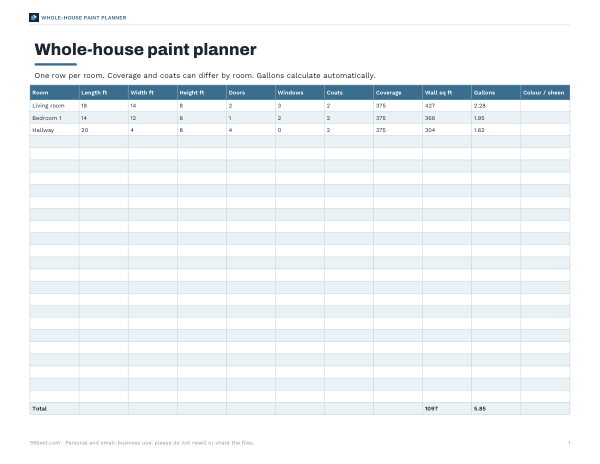
Whole-House Paint Planner
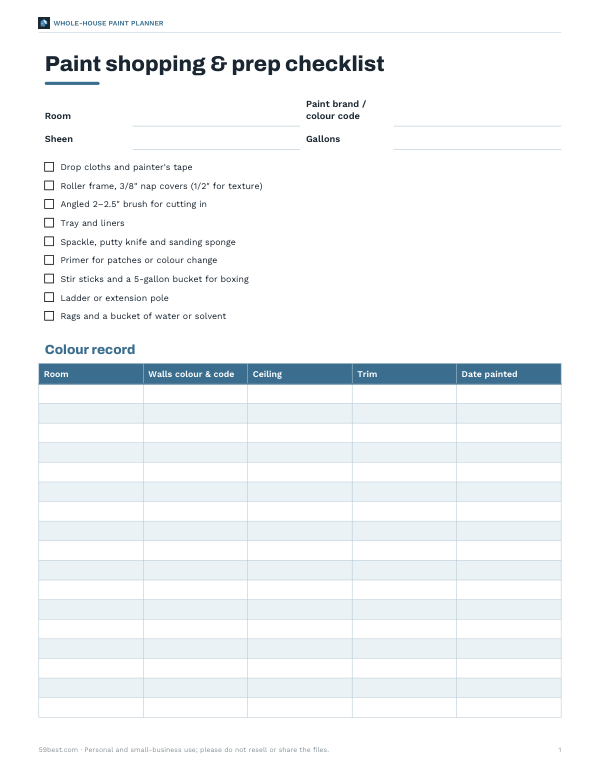
Plan every room at once — walls, ceilings and trim — with a colour and supply schedule you can take to the store.
- Room-by-room paint workbook (XLSX, PDF)
- Shopping & prep checklist (PDF, DOCX)
Formats: XLSX, PDF, DOCX. Instant download after payment (link valid 72 hours, up to 5 downloads). AI-assisted: the templates were drafted with AI help and reviewed and laid out before publishing.
$4.00 USD, one-time
- Instant download
- 7-day refund
- Secure checkout by Stripe
7-day money-back guarantee. Full refund within 7 days of purchase, even after you download.
Full refund within 7 days — see the refund policy and license.
Free printables
Single sheets you can print right now, no sign-up. The full pack adds every sheet in one download plus the editable files.
How the paint calculator works
Paint is bought by the gallon, but walls are measured in feet, so the calculator converts one into the other in three steps. First it finds the gross wall area: the perimeter of the room (twice the length plus twice the width) multiplied by the wall height. Then it subtracts the openings you will not paint — about 20 square feet for a standard interior door and 15 square feet for an average window. Finally it multiplies the paintable area by the number of coats and divides by the coverage printed on the can.
- Perimeter = 2 × (length + width).
- Gross wall area = perimeter × wall height.
- Paintable area = gross area − (doors × 20) − (windows × 15).
- Gallons = paintable area × coats ÷ coverage per gallon.
If you know the exact size of a large opening such as a patio door or picture window, add it as the equivalent number of doors or windows, or reduce the room length slightly to compensate.
What coverage figure should I use?
Most interior wall paints list coverage of about 350 to 400 square feet per gallon for one coat on smooth, primed drywall. The calculator defaults to 375. Real coverage is lower on rough, porous or textured surfaces, and when you roll on a thick coat. Use the figure on your chosen product's label when you have it.
| Surface | Typical coverage per gallon | Notes |
|---|---|---|
| Smooth, previously painted drywall | 350–400 sq ft | Same or similar colour |
| New drywall (after primer) | 350–400 sq ft | Prime first; bare drywall soaks up paint |
| Primer on new drywall | 200–300 sq ft | Use a drywall primer-sealer |
| Light texture (orange peel) | 300–350 sq ft | More surface area to fill |
| Heavy texture, brick, block | 150–250 sq ft | Use a thick-nap roller |
| Bare wood trim | Varies | Prime knots and bare wood first |
How many coats do I need?
Two coats is the usual answer. The first coat covers and seals; the second evens out colour and sheen and hides roller marks. One coat can be enough when you repaint with a similar colour over a sound surface, especially with a high-hiding paint. Plan on three coats, or a tinted primer plus two coats, when you make a big colour change — dark to light, or to a deep red, yellow or navy that has less hiding power.
Worked example
A bedroom is 14 feet by 12 feet with 8-foot walls, one door and two windows. The perimeter is 52 feet, so the gross wall area is 416 square feet. Subtracting 20 square feet for the door and 30 for the windows leaves 366 square feet. Two coats at 375 square feet per gallon need 366 × 2 ÷ 375 = 1.95 gallons. You would buy two gallons. If you are also painting the 168-square-foot ceiling with the same paint, the total rises to 534 square feet and 2.85 gallons — three gallons, or better, one 5-gallon bucket if the price per gallon is lower.
Gallons, quarts and five-gallon buckets
A gallon is four quarts. Quarts suit touch-ups and small spaces, but three quarts usually cost more than a gallon, so the calculator rounds up to a full gallon when you would need three or more quarts. For large projects, a 5-gallon bucket is often cheaper per gallon and keeps colour consistent across walls. If you buy several gallons of a custom tint, pour them together into a larger bucket and mix — a technique called boxing — so every wall matches.
Measuring the room accurately
- Measure wall length along the floor from corner to corner and round up to the next half foot.
- Measure height from the floor to the ceiling, not to the top of the trim.
- For rooms with a sloped ceiling, measure the height at both ends and use the average for those walls.
- For an accent wall, set the width to zero and enter the wall length as the room length; the calculator then counts that wall twice, so halve the result, or enter half the wall length.
- Keep the calculation for trim and doors separate: they are usually painted in semi-gloss with a brush.
Painting order and drying time
Work from the top down so drips land on surfaces you have not painted yet: ceiling first, then walls, then trim and doors, and finally baseboards. Cut in the corners and edges with a brush before rolling each wall, and roll while the cut-in edge is still wet to avoid visible bands. Most latex wall paints are dry to the touch in about an hour and ready for a second coat in two to four hours, but humidity and cool rooms slow this down; the can gives the manufacturer’s recoat time. Leave furniture off freshly painted walls for a few days, because latex paint takes several weeks to reach full hardness even when it feels dry.
Other paint you might forget
Budget a little extra for touch-ups later and for the inevitable drips on the tray. Ceiling paint is usually a flat white sold separately. Trim and doors take about a quart per room for a typical bedroom, more for wainscoting or many windows. If walls have stains, water marks or glossy old paint, a stain-blocking or bonding primer saves coats of finish paint.
Frequently asked questions
How much paint do I need for a 12×12 room?
With 8-foot walls, one door and one window, the paintable area is about 349 sq ft. Two coats need roughly 1.9 gallons, so buy two gallons.
Does primer count as a coat?
Primer seals the surface and improves adhesion and colour, but it is not a finish coat. Most projects still need one or two finish coats over primer.
How much area does a gallon of paint cover?
About 350–400 sq ft per coat on smooth, primed walls; less on texture or bare surfaces.
Should I buy extra?
A small margin helps for touch-ups. Keep leftover paint sealed and labelled with the room name.
Is the cost estimate exact?
No. It multiplies the cans you buy by the price you enter; brands, sheens and store promotions vary.